
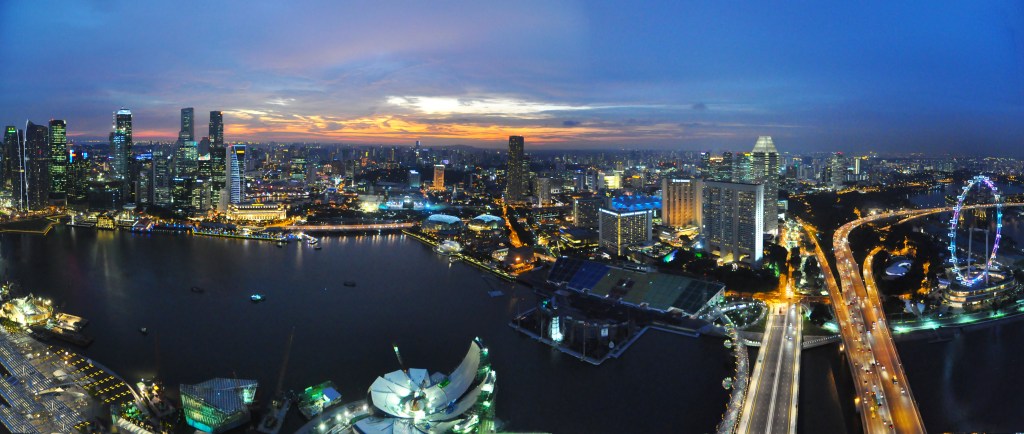
Singapore is by most measures a very successful country. It is an economic powerhouse ranking as one of the most open and globally competitive countries with strong financial and manufacturing sectors. It boasts one of the world’s highest GDPs per capita and strong economic stability across all social strata. It is a major player in global trade, logistics, and finance, playing a key role in international organizations like the Asia-Pacific Economic Cooperation (APEC), World Bank Group, ASEAN as well as other NGO/IGOs like World Wide Fund for Nature (WWF), and Humanitarian Organisation for Migration Economics (HOME), Global Esports Federation (GEF), and International Association of Lighthouse Authorities (IALA). Governmental systems incentivize low corruption and high efficiency that yields an enviable network of human capital in form of strong education, housing, and healthcare programs creating a virtuous cycle of growth.
It does have an authoritarian form of government though… somewhat!
Singapore’s success poses an uncomfortable question for people who instinctively distrust concentrated power. We students of history have come to rely on the grounding principles of freedom and equality when it comes to our governance. ‘No Kings’ right? Can an unfree political system truly be a good thing? Can we sacrifice liberal democracy at the altar of good governance? At its core, Singapore represents a form of performance-based authoritarianism that most of us cannot digest. Political competition is constrained, dissent is managed, and power is centralized. In return, the state promises safety, prosperity, efficiency, and predictability. For decades, it has delivered. This isn’t accidental. Singapore was born under conditions that rewarded decisiveness over deliberation: no natural resources, ethnic tensions, and a precarious geopolitical position. In such an environment, pluralism could easily have become paralysis. Strong control was not presented as an ideology, but as a survival strategy. Singapore’s success from this “soft autocracy” or “managed democracy” is one of the most studied cases in modern political and economic history.
Historical Context: When Malaysia expelled Singapore, creating a forced independent country in 1965, Singapore was tiny (no natural resources, no hinterland); riven by ethnic tensions, economically fragile, dependent on entrepôt trade. Lee Kuan Yew (the founding Prime Minister) and his People’s Action Party (PAP) inherited a country that could have easily failed. In his memoir he writes, “Some countries are born independent. Some achieve independence. Singapore had independence thrust upon it.” That sense of existential vulnerability justified strong, centralized authority: efficiency over pluralism and as a leader who owed his career to championing “Malaysian Malaysia” a program that tried to unite Malay and Chinese and Tamil communities together, Lee Kwan Yew took his role as leader with deep anguish.
Technocratic Governance: Singapore’s leaders built a government based on competence, meritocracy, and long-term planning. Ministers were highly educated, often from top global universities. Policies were evidence-based, not populist. Civil servants were well-paid to reduce corruption and attract talent. This created a technocratic elite—authoritarian in control, but rational and data-driven in policymaking. Housing, education, infrastructure, and industrial policy were planned with a long time horizon, insulated from electoral mood swings. In many democracies, these systems exist in theory; in Singapore, they actually function.
Economic Pragmatism: Singapore’s model mixed capitalism with state direction. The government created state-owned enterprises (Temasek Holdings, GIC) that operate on commercial principles. It welcomed foreign investment, offering stability, low corruption, and skilled labor. Infrastructure, housing, and education were built in a coordinated, top-down fashion. This mix made it one of the world’s easiest places to do business, even without full political freedom.
Social Discipline: The state cultivated a culture of law, order, and communitarian values. Strict laws against dissent, corruption, and public disorder. The media and public discourse were tightly managed. “Asian values” were emphasized, prioritizing collective good over individual freedom. Critics call this authoritarian paternalism, but many citizens saw it as a transactional governance that ensured stability and prosperity. Singaporeans are not collectivist in the romantic, Confucian sense of selfless communal harmony. They are intensely competitive, status-conscious, and market-oriented. What exists instead is instrumental collectivism: public discipline paired with private ambition. People follow rules not because the community is sacred, but because the rules are enforced, predictable, and clearly linked to outcomes. The idea was to incentivize social ‘good.’
Managed Democracy: Singapore holds regular elections, but, the PAP dominates politics. Opposition parties face structural disadvantages (media control, defamation suits, gerrymandering). The political culture prizes competence and results over ideological pluralism. The result: continuity, predictability, and little populist chaos — though at the cost of political diversity.

While successful, the model has trade-offs. With a government that runs ‘well’ on limited press freedom, low political dissent, and a controlled society, the risk of complacency or groupthink sits right at the top. Yet, because the leadership has generally reacted to the times appropriately, has maintained a clean, capable, and effective outcome, the system has retained legitimacy. More through performance than ideology – a clean, competent bureaucracy; a pragmatic economic model; a disciplined, cohesive society managed by a leadership elite that uses control to ensure growth. It is authoritarian in politics, liberal in economics and pragmatic in governance. In this kind of an environment, what we get is high competence but low epistemic diversity. When problems are technical (housing, sanitation, trade logistics) this works just fine, but when problems start getting cultural, moral, or adaptive (identity, inequality, meaning, legitimacy) there is a decreased density of ideas or solutions. Smart people thinking alike can be just as dangerous as incompetent ones arguing. I realize this is splitting hairs on a beetle’s ass and is barely a problem until now, but it is a philosophically laden impediment.
The second risk is fragile legitimacy. Singapore’s social contract is transactional: less political freedom in exchange for results. Democracies survive failure because legitimacy is procedural: when leaders fail, people can vote them out. Performance-based systems don’t have that cushion. An economic downturn, rising inequality, or generational value shift can quickly turn quiet consent into silent resentment. And this can be magnified by the third challenge that comes from the modern information environment. Singapore’s model was built in an era of information scarcity, when narrative control was easier and global comparison slower. The internet collapses those barriers. Citizens today are exposed to alternative political arrangements, moral vocabularies, and identities. Singapore has responded not with heavy censorship, but with legal and reputational friction: defamation laws, regulatory pressure, and careful media framing. This works, but it becomes harder to justify as education levels rise and existential insecurity falls.
Another of Singapore’s Sword of Damocles is the corruption of power. The country’s long‑standing dominance by a single party, the PAP, combined with a highly centralized executive, creates the kind of political architecture and latent vulnerability that reeks of the typical corruption of power led by special interest groups that can place political puppet slash strongmen to capitalize on democratic fail-points. Case in point, USA. The Prime Minister’s office wields significant influence over policy direction, appointments, and institutional culture, and leadership transitions are typically managed internally rather than through competitive political contestation. These features can, in theory, create openings for a dominant personality or oligarchy to reshape the system around themselves, especially during moments of uncertainty or succession.
Analysts have noted that the post–Lee Kuan Yew era has exposed certain vulnerabilities, including the fragility of leadership renewal and the potential for political turbulence if internal consensus weakens. Yet the other side of the equation is equally important: Singapore’s political culture, institutions, and electorate have evolved in ways that make strongman politics far less likely than the structural risks might suggest. Leadership succession, while tightly managed, is also highly institutionalized, with deliberate planning and collective decision‑making designed to prevent the emergence of personality‑driven rule. The electorate has become more demanding, more vocal, and more willing to challenge the government, with PAP leaders themselves acknowledging that every future election will be more competitive.
Singapore’s legitimacy has historically rested not on populist charisma but on technocratic competence, performance, and trust in the civil service, which remains professional, insulated, and continuity‑driven. These bureaucratic and legal institutions act as stabilizing forces that limit the space for personalist rule. The potential exists, but the safeguards are real, and the country’s trajectory so far suggests a system designed to resist the gravitational pull of strongman politics even as it navigates the complexities of long‑term single‑party rule.
Comparing this with Europe and North America clarifies the trade-offs. Singapore optimizes for competence and coordination. Europe prioritizes fairness, dignity, and institutional restraint, even at the cost of speed. North America maximizes freedom and innovation, tolerating chaos and polarization as the price of openness. Each model answers a different question: Singapore asks how to govern well, Europe how to govern fairly, and North America how to govern freely. You can’t maximize all three at once.
The deeper question is whether Singapore’s model can evolve without breaking. As citizens become wealthier, more educated, and more globally connected, the desire shifts from efficiency to meaning, from outcomes to voice. At that point, paternalism, however benevolent, starts to feel insufficient. Singapore’s greatest test will not be economic or administrative. It will be philosophical: can a system built on results alone generate lasting legitimacy in a world that increasingly demands participation? I’m not holding my breath, though, given Singapore’s continued success even with the length of time it has already been exposed to the ‘allside’ (down/up) of technological, economic and social dirt that the globe has wallowed through and its ability to tide over them because of a strong interlay of bureaucratic, technocratic and socio-political meeting of minds.
The philosophical tension though, more than anything, defines both the brilliance and the fragility of the Singaporean experiment.
 My 2 cents