
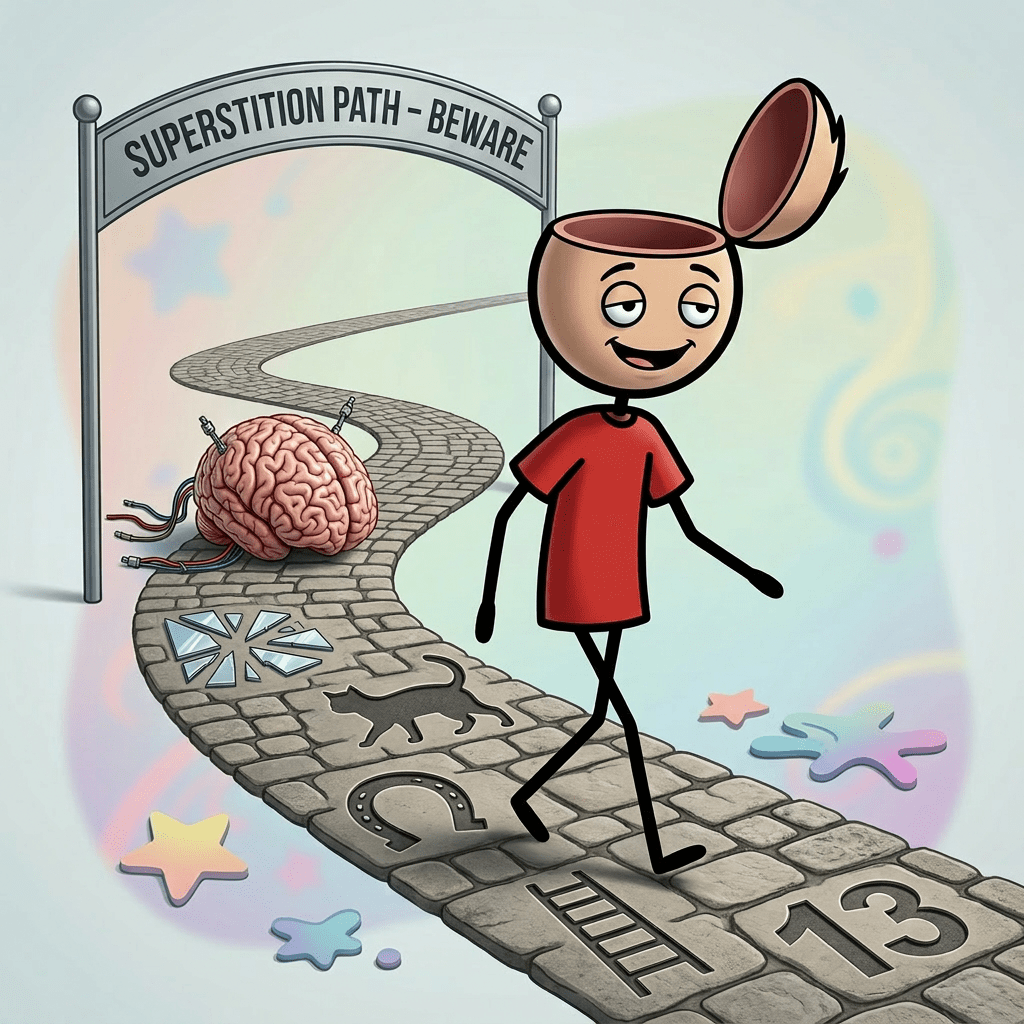
The exhortation to ‘keep an open mind’ on unproven proposition is fascinating for a scientifically motivated person because the truly scientific are indeed carrying that very burden – of allowing room for evidence! It is not easy. Much easier to shut down conversation, or further investigation, by being certain about something and getting agitated at others who don’t hold your position! It gets at the boundary between evidence-based reasoning and belief-based reasoning as a method to get closer to truth.
And it is not just religion but also many other forms of belief that share characteristics with religion or superstition without necessarily being religious. Paranormal beliefs such as believing existence of ghosts, psychic powers, telepathy, astrology, mediums, alien visitation. Pseudoscientific health claims like homeopathy, detox cleanses, energy healing and miracle supplements.
Among the most negatively impactful of irrationalities, at a global scale right now, is ideological certainty. Holding political, economic, or social beliefs with near-religious conviction that ends up looking like, “My political side is fundamentally good” or “Market forces solve everything” or “Government intervention solves everything.” Personal myths such as people going through life thinking they are exceptionally good judges of character or that they are objectively rational or that success is mostly due to merit or that failure is mostly due to bad luck or even deserved because of who someone is.
Psycho-socio-political studies repeatedly show humans are prone to self-serving biases and overconfidence. As are the silly ones that lead to conspiracy beliefs about secret groups controlling world events, faked news and events, hidden knowledge being suppressed. The issue is often not that conspiracies are impossible, but that evidence standards become asymmetrical: evidence against the theory is interpreted as proof of the conspiracy.
Technological utopianism, on the flip side, is also treacherous ground for influencing real life. Beliefs that AI will solve most human problems or that technology will inevitably improve society or that all scientific progress automatically leads to moral progress are also devoid of the rational ramp that we use to get on the worldview highway!
All of these are testable in principle, but evidence has remained elusive despite decades of investigation. These also borrow scientific language while lacking reliable supporting evidence. These are partly forecasts and partly articles of faith. So what allowance should a scientist give? A scientist should almost never assign zero probability to a claim. One of the great lessons of science is humility. Historically, many ideas sounded absurd before evidence emerged: continental drift, germ theory, meteorites falling from space
Quantum mechanics, deep-sea ecosystems around hydrothermal vents!
The scientific attitude is more about reserving any form of judgement based on certainty. Instead of dividing ideas into “believe” and “don’t believe,” it falls upon us, as in every case of decision-making with none to low information, to rely on degrees of confidence. For example: Earth orbits the Sun? >99.99999%. Evolution by natural selection? >99.999999%. Life exists elsewhere in the universe? Plausible but uncertain. Alien visitors are currently visiting Earth? Very low confidence. Astrology predicts personality? Extremely low confidence. Telepathy exists? Very low confidence but not literally impossible
These degrees are important and that is the mindset to cultivate. There is danger at both extremes. Extreme scepticism (reject everything until proven 100% leading to lack of a ‘discovery’ ‘innovation’ attitude) versus extreme credulity (accept extraordinary claims on weak evidence leading to superstition, pseudoscience, and misinformation.) Science occupies a middle position – remain open to any possibility, but proportion belief to evidence and if you have the resources, go ahead and assign degrees of confidence to models that attempt to explain the truth; fine-tune the map if visiting the place is not possible.
This is the principle associated with David Hume and later popularized by Carl Sagan in the phrase: Extraordinary claims require extraordinary evidence. As a person of science, we do not need to believe or vehemently reject unproven claims. We merely need to avoid claiming certainty. The scientifically defensible position is often: “I would change my mind if compelling evidence appeared.” That stance preserves both scepticism and intellectual honesty.
As the quintessential sceptic says ” Keep an open mind, but not so open that your brain falls out!”

